






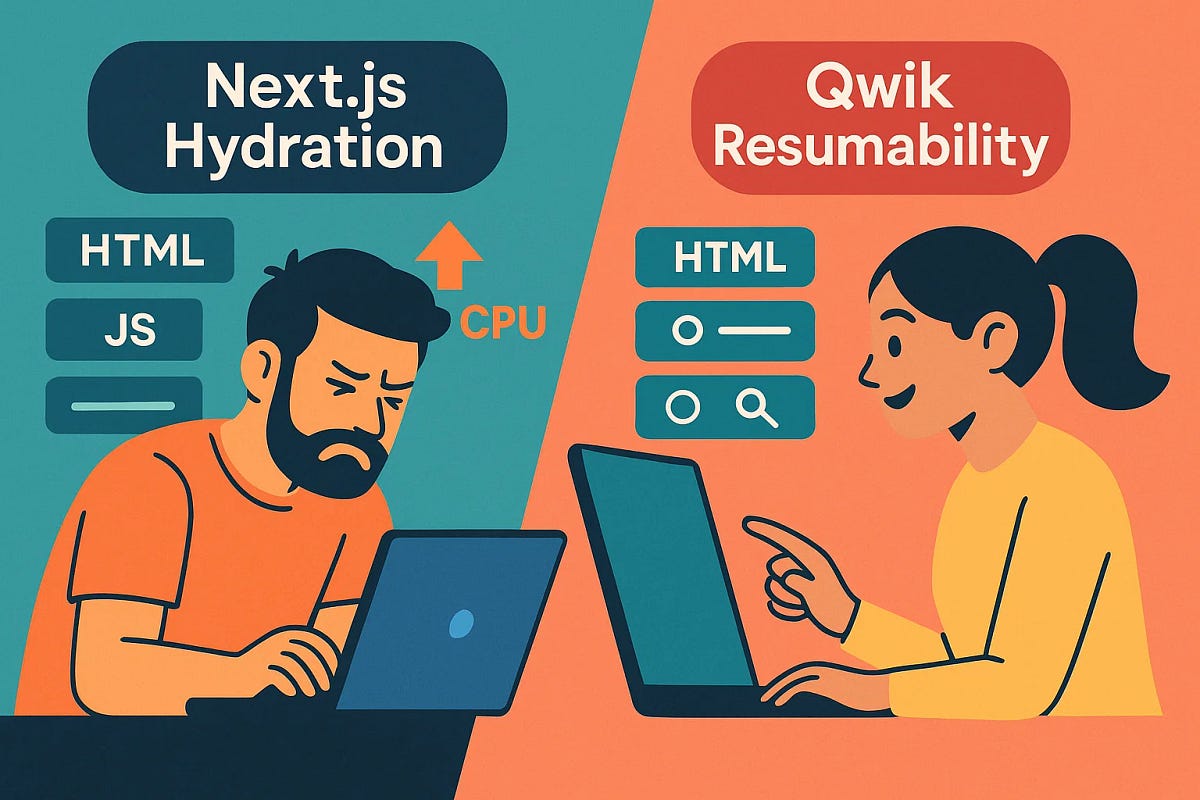
Next.js vs. Qwik.js: The 2026 Performance Showdown
The web is evolving faster than ever. Users expect pages to load instantly, respond immediately, and feel smooth across devices. Today, performance is no longer a “nice to have”, it’s a core requirement.
This growing demand has sparked a major shift in frontend development. Two frameworks often discussed in this context are Next.js and Qwik.js. Both aim to build fast, modern web applications, but they take very different approaches.
While Next.js has long been the gold standard for full-stack React applications, Qwik.js has emerged as a serious challenger by questioning the very foundation of how we deliver JavaScript: Hydration.
Is the “Hydration Tax” a price we still need to pay? Let’s dive into the shift from Next.js’s maturity to Qwik’s innovative “resumability.”
So the real question is not which framework is better, but rather:
Do we still accept hydration delays in 2026?
Understanding the Performance Shift in Frontend Development
For years, frontend frameworks have relied on hydration, a process where JavaScript takes over a server-rendered page to make it interactive. While this works well, it also comes with a cost: extra JavaScript and delayed interactivity.
As websites grow more complex and users become less patient, developers are rethinking this model. This is where Next.js and Qwik.js differ most.

Next.js: The Reliable Powerhouse, The Enterprise Favorite
Next.js has become one of the most widely used React frameworks in the world, and for good reason.
Next.js remains the dominant force for enterprise-grade applications. With the release of Next.js, it has leaned heavily into React Server Components (RSC) and Partial Prerendering (PPR) to bridge the performance gap.
-
The Ecosystem Advantage:
In 2026, Next.js still boasts the largest library of plugins, themes, and community support. If you’re building a complex SaaS with heavy third-party integrations, the “Vercel-backed” safety net is hard to ignore.
-
The Hydration Cost:
Despite RSCs significantly reducing the amount of JavaScript sent to the client, interactive components still require Hydration. This is the process where the browser downloads the component logic, executes it, and attaches event listeners to the static HTML. On low-end mobile devices, this can still cause a noticeable “uncanny valley” where the page looks ready but doesn’t respond to clicks.
Why Developers Love Next.js
- A mature ecosystem with strong community support
- Powerful Server-Side Rendering (SSR)
- React Server Components (RSC) for optimized rendering
- Excellent tooling for large-scale and enterprise applications
Next.js performs extremely well for complex dashboards, SaaS products, and applications with heavy business logic.
The Trade-Off
Even with all its optimizations, Next.js still relies on hydration. This means users may experience small delays before the page becomes fully interactive — especially on slower devices or networks.

Qwik.js: The King of “Instant-On”
Qwik.js introduces a completely different way of thinking about frontend performance. Instead of hydration, Qwik uses a concept called resumability. Qwik represents a fundamental shift in frontend architecture. Instead of optimizing hydration, it eliminates it entirely through a concept called Resumability.
-
Resumability > Hydration:
Qwik serializes the application state and event listeners directly into the HTML on the server. When the page hits the browser, it doesn’t “re-run” the app. It simply resumes where the server left off.
-
Ultra-low JS:
Qwik delivers a “zero-JS” initial load. JavaScript is only downloaded as the user interacts with specific elements. If a user never clicks the “Buy Now” button, that button’s code is never even downloaded.
-
SEO & Core Web Vitals:
Because the Time to Interactive (TTI) is virtually identical to the First Contentful Paint (FCP), Qwik apps consistently score 100/100 on Lighthouse, making it a dream for SEO-sensitive content hubs.
What Makes Qwik.js Different?
- Ships very little JavaScript initially
- Pages are interactive almost instantly
- JavaScript loads only when needed
- No traditional hydration step
This approach makes Qwik.js especially powerful for content-heavy websites, marketing pages, blogs, and performance-critical experiences.
The Catch
Qwik.js is still relatively new.
Its ecosystem is smaller, and it may not yet be ideal for very large or highly complex enterprise systems.
Hydration vs Resumability: Why It Matters
Hydration:
- Loads JavaScript upfront
- Delays interactivity
- Heavier initial payload
Resumability:
- Loads only what’s needed
- Faster time to interaction
- Better performance on low-end devices
As performance expectations rise, resumability challenges the assumption that hydration is unavoidable.
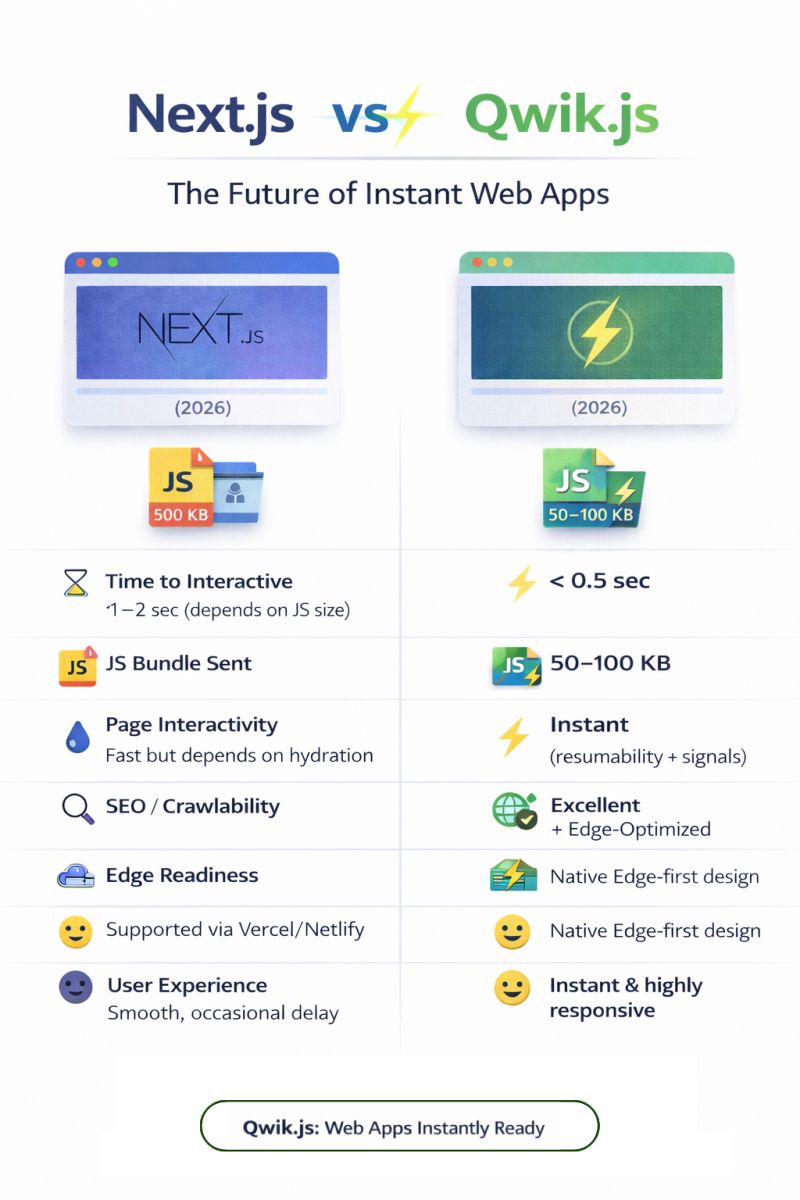
📊 Head-to-Head Comparison
| Feature | Next.js (2026) | Qwik.js (2026) |
| Core Philosophy | Hydration & Streaming | Resumability |
| Initial JavaScript | Medium (Optimized via RSC) | Near Zero |
| Time to Interactive | Fast (Device Dependent) | Instant |
| Developer Experience | High (React ecosystem) | Moderate (Unique syntax) |
| Best For | Enterprise, SaaS, Complex Dashboards | E-commerce, Marketing, Blogs |
🏁 The Verdict: Which One Wins?
The answer depends on what you are building:
- Choose Next.js if you need a mature ecosystem and your team is already deep in the React world. It is the “safe” bet for long-lived enterprise applications where developer hiring and library support are the highest priorities.
- Choose Qwik.js if conversion rates and speed are your primary KPIs. For e-commerce sites or content-heavy platforms where every millisecond of delay means lost revenue, Qwik’s ability to bypass the hydration tax is a competitive superpower.
In 2026, we are finally moving past the era of “heavy” web apps. Whether you stick with the refined power of Next.js or embrace the instant-on future of Qwik, the goal remains the same: Stop making the user wait.
Final Thoughts: The Future of Web Performance
Next.js will likely continue to dominate enterprise and large-scale applications. Its stability and ecosystem make it hard to replace.
At the same time, Qwik.js represents the future of performance-first web development. As users demand faster experiences, ideas like resumability may become the new standard.
The real debate isn’t Next.js vs Qwik.js —
It’s whether developers will continue to accept hydration delays in the years ahead.
